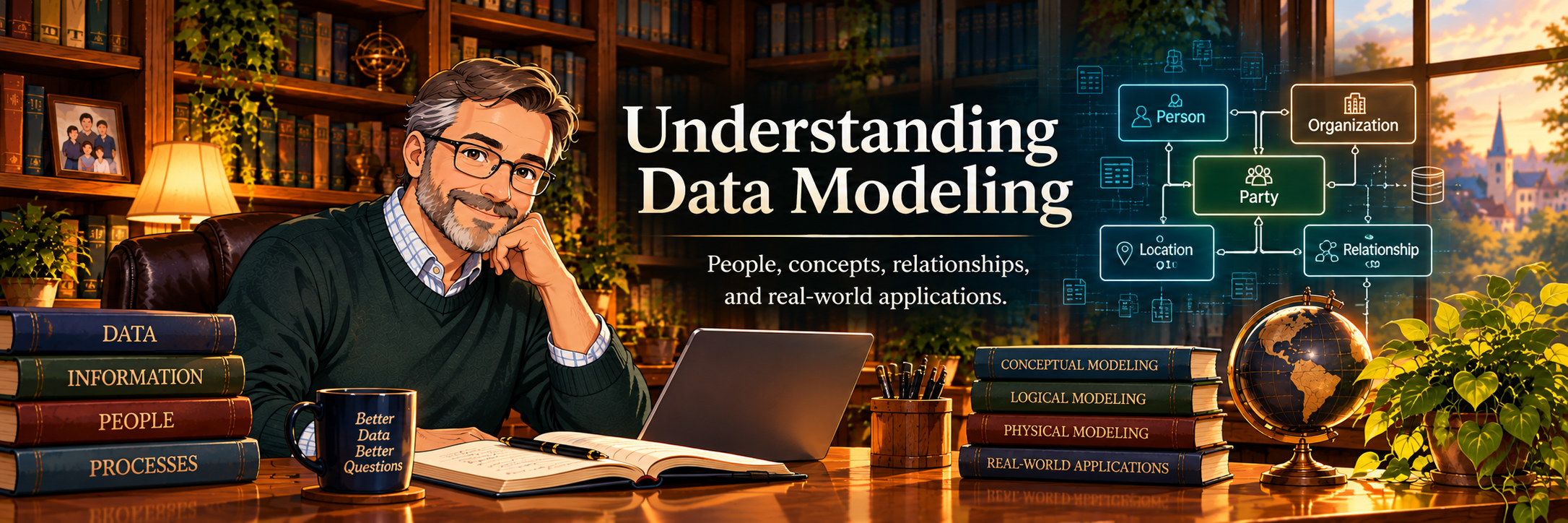
The central idea behind the Party Model is the separation of identity from role.
Identity answers the question:
“Who is this person or organization?”
Role answers a different question:
“What part does this person or organization perform in a particular business context?”
Consider a person named Maria.
Maria may be:
- An employee
- A customer
- A volunteer
- A supplier contact
- A member of a professional organization
Those are not five different people. They are five roles performed by the same person.
Information such as Maria’s name and identifying details describes the party. Information such as her employee number, customer account, volunteer assignment, or supplier responsibilities describes a particular role or relationship.
This distinction matters because roles change.
Maria may leave her employment but remain a customer. She may stop volunteering and later become a contractor. Her roles can begin, end, overlap, or change while her underlying identity remains the same.
If each role is modeled as a separate person, the organization may create duplicate records and lose the ability to recognize that those records refer to the same real-world individual.
Separating Identity from Business Context
The Party Model separates these concepts:
- Party records the identity.
- Party Role records the capacity in which the party participates.
- Party Relationship connects one party to another within a defined context.
This allows the model to preserve one identity while supporting multiple roles over time.
The distinction also helps determine what information describes the underlying identity and what information describes a particular business context.
A person’s name describes the person. An employee number describes the person’s employment context. A customer account number describes a particular customer context.
A useful test is to ask:
“Would this information still describe the person or organization if this particular role ended?”
If the answer is no, the information probably belongs with the role or relationship rather than with the party’s identity.
Next in This Series
Return to the Understanding Data Modeling Series Index
For More Information
The Party Model and the patterns discussed in this series are strongly influenced by the work of Len Silverston.
For a deeper treatment of reusable data modeling patterns, including party roles, relationships, classifications, hierarchies, and contact mechanisms, see:
Len Silverston and Paul Agnew, The Data Model Resource Book, Volume 3: Universal Patterns for Data Modeling, Wiley.
Additional articles and historical material from The Data Administration Newsletter (TDAN) are available through DATAVERSITY.


Leave a Reply